Showing posts with label Mike Leigh. Show all posts

Friday, February 12, 2016

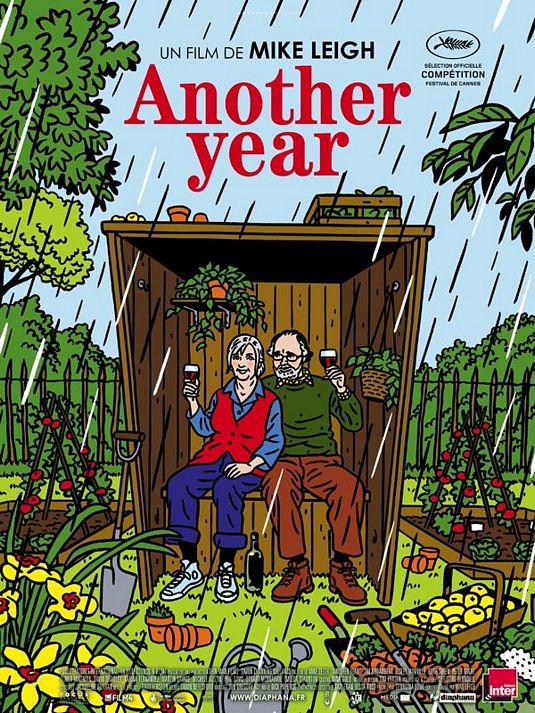
Another Year


Gardening is a chore—the weeds, the watering, and the waiting to taste that first tomato. But the law of the harvest is so much more than the final product (though that’s especially nice). It’s perceiving the movement of air, the feel of the soil, and the bending of muscle. When Gerri lifts her face to the sun and breathes in the moment, I know she understands.

Poor Mary trying to live off borrowed light. As the dinner party reminisces about the past, Mary is left “outside” looking in.  She recognizes the light and wants to bask in it, but it’s not hers and she’s unable or unwilling to create her own.

Pieces of Lou Reed’s song, “Perfect Day” kept playing in my head throughout the film.

You just keep me hanging on…

Just a perfect day
You make me forget myself
I thought I was someone else
Someone good

You're going to reap just what you sow…

Tuesday, February 2, 2016

A Sense of History

The aristocracy façade crumbles as Jim Broadbent walks us through the story of The 23rd Earl of Leete. 

Mike Leigh, making a departure from directing his own material, understatedly captures Jim Broadbent’s biting social commentary. Athena-51 posted on IMDb that A Senseof History was “ingeniously crafted with Jim Broadbent entrapping me perfectly in his web.”  I too was caught up and for a moment forgot that it was a spoof of the politics of the times. This pointed approach is much more effective than an all out rant or broad satire. Broadbent, standing in the frigid water reenacting a moment in his past, will stay with me forever.

The Earl of Leete defending his support of Hitler reminded me of The Remains of the Day and the dilemma the butler had with his employer’s loyalties. He said, "Lord Darlington wasn't a bad man. He wasn't a bad man at all. And at least he had the privilege of being able to say at the end of his life that he made his own mistakes. His lordship was a courageous man. He chose a certain path in life, it proved to be a misguided one, but there, he chose it, he can say that at least. As for myself, I cannot even claim that. You see, I trusted. I trusted in his lordship's wisdom. All those years I served him, I trusted I was doing something worthwhile. I can't even say I made my own mistakes. Really - one has to ask oneself - what dignity is there in that?" 


While The Remains of the Day uses this quiet, fatalistic, detached dialogue to create a sense of history, A Sense of History uses it as a wakeup call by infuriating the audience.