Showing posts with label Ingmar Bergman. Show all posts

Sunday, August 6, 2017

Scenes From a Marriage

I could write this with circumspection and objectivity, but that ain’t gonna happen.

First off, I’ll get the rant out of the way, but promise to go back and look at the characters with compassion once I’ve gotten it out of my system.

I don’t understand. From the pages of notes that I’m jotting down while watching, these are the words that appear the most.

I don’t understand Marianne’s attraction to Johan. 

There, I said it. I am truly put off by his coldness and arrogance (All a front? Don’t worry; I’ll get back to this). Physically, Marianne reacts negatively to it as well. During the opening scene, while being interviewed, her body language speaks loud and clear. She is so uncomfortable with his boasting; tugging at her collar, elbowing him slightly, glancing sideways. I’m squirming along with her for that is such an awful place to be; trapped to bad behavior by association. Continuing on with the physical, Johan says later that he hated her as he felt her indifference when having sex and is confused why his “bad behavior or criticism made [her] withdraw.” 

And I say, No duh. 

Heaven forbid he put any effort at being consistently kind into his relationship. Marianne has so much natural affection for him, that the formula is so simple—he treats her with care and she’s his. But he can’t be bothered--such a selfish, myopic view that doesn’t serve him well. Even his kisses are awful; self pleasure instead of giving, but she likes them. Go figure.

Okay, on to Marianne. Even though her body instinctively reacts to his behavior, she doesn’t allow her mind to do so. Projecting on to him what she wishes he would be, she lives the illusion. Can she not see that as she prattles away, he’s not there? He left long ago in realization that she wasn’t going to really see him. What would be the point of sharing his poetry? Subterfuge is the kiss of death. I know that Marianne’s story is one of ascending, but it’s so torturous watching her react to her husband’s infidelity—all nurturing (Make him breakfast? Really?) and begging (Anything but that!) and then displacing her anger towards her friends who are privy to the situation. (I couldn’t take it anymore and had to go for a walk.) There is one aspect of Marianne that’s dizzying. Sometimes her emotions turn on a dime and I have to go back and try and figure out what exactly Johan said or watch her face as she goes through a thought process to find the trigger. As a woman I understand triggers, but hers are so abrupt that all I can think is, “Poor Johan, he doesn’t stand a chance at figuring all this out.”

Now for a little compassion, which I do see is peaking out in the two previous paragraphs. Johan is acutely alone. His wife and girlfriend don’t completely know him, but it’s not surprising since he doesn’t have a grasp on who he is either—which belie his bombastic remarks at the beginning. And, oh how I’m loving Marianne’s self discovery. Words like “whether the potential for joy that was innate in me is dead, or whether it merely lies dormant and can be awakened” resonates. Zing!

Everything up to this point was written before seeing the last scene. The shifting moral sands are onerous for me to traverse, but there is some real communication happening between the characters that on one hand is pitiful and on the other beautifully genuine, since they have each arrived at some place new. My next step is to look for reviews to help me see it from other perspectives, for mine is not enough.

Oh yeah, but what about it being a movie? I forgot about the camera; every episode I clean forgot and that’s the highest praise I know.

I'm exhausted and am in need of a virtual hug. 


Monday, December 5, 2016

Persona

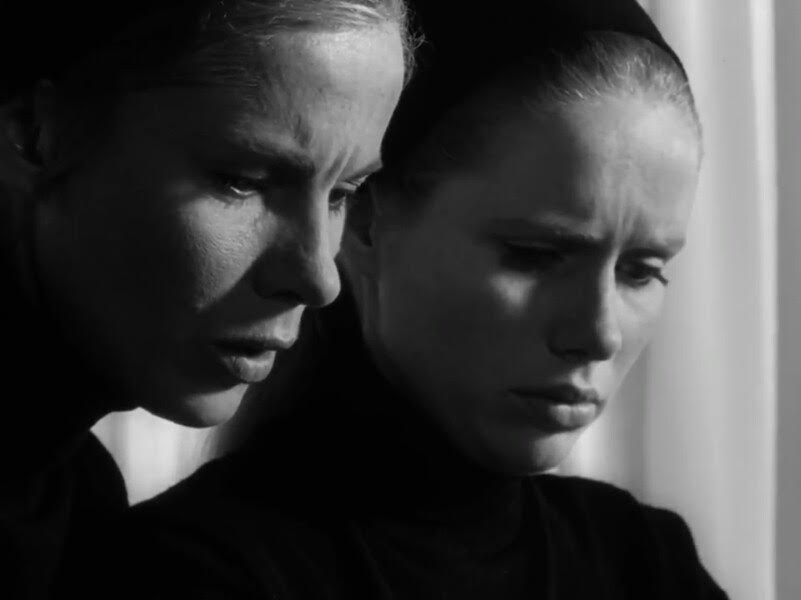
Alma pours herself into Elizabet with words, which frees up space to draw in Elizabet's demeanor, reputation and all that Alma can only speculate on, but at what cost? 

Elizabet receives Alma in, as a study, but slowly, imperceptibly Alma's living seeps into places that have been shut down and Elizabet is forced to face all that's been locked away. 

The melding of lives both pollutes and purifies, but isn't that both the price and the prize of "not seeming, but being?"

Sunday, October 23, 2016

Wild Strawberries

Not what I expected. For some reason I thought this was going to be a type of A Christmas Carol, exploring the redemption of a cold, heartless man. 

But this was no Phantom Carriage Victor Sjöström.  His Dr. Isak Borg wasn't cruel or vindictive, nor was he without feeling, but a man without the faculties or inclination to explore them. He wasn’t even completely isolated as his housekeeper fulfilled his need for interaction--two quietly contented individuals. I didn't feel the cold from him, but instead a pale warmth that needed memories and exchanges to spark the embers and stoke the heat of living--stirring up the pain and the joy. 

I disagreed with Marianne, and I think she came to the same realization as I did by the end. She was wrong about Dr. Borg's mother as well. Beneath the well worn pathways of complaints, was an interesting woman who was lonely and had a lifetime of experiences to share if someone would just stay for a while. Even inside Dr. Evald Borg smoldered some heat, mostly from pain, but also for love of Marianne. Truly an affirming film watching experience.


The Seventh Seal

Four Approaches to Death

Karin:
With Serenity
"Quiet, quiet."
Corresponding Quote: "Peace I leave with you, my peace I give unto you." John 14:27


Antonius Block:
With Searching
"Out of our darkness we call to thee, O Lord!"
Corresponding Quote: "I believe; help thou in mine unbelief."  Mark 9:24


Girl:
With Anticipation
"It is finished."
Corresponding Quote: "I have fought a good fight, I have finished my course, I have kept the faith." 
Timothy 4:7


Jöns:
With Pragmaticism
"In the darkness where you say you are there is none to listen to our lament."
Corresponding Quote: "It is far better to grasp the Universe as it really is than to persist in delusion, however satisfying and reassuring." Carl Sagan


The film leaves me with the question, which one am I? Maybe, depending on the day, I've been each one of them. The Seventh Seal has been a very satisfying and thought provoking film and deserves nominations and awards sent its way.

Wednesday, December 9, 2015

Through a Glass Darkly

I’m more than a little sheepish to say that this is the first complete IngmarBergman film that I’ve seen. Clips are not enough. This was powerful, earth shattering cinema. Before I saw it, I was told that it was a dark, despondent film. Not necessarily so. There was so much light bursting through at the end that I could barely gather it all in. It’s humanity at its most vulnerable and poignant.

When Karin went to the attic room, I wondered if the wallpaper was yellow. I couldn’t stop thinking about that wallpaper. Was Bergman referencing the unforgettable short story by Charlotte Perkins Gilman? Later, I read that the original Title of the film was The Wallpaper.  
Yes, there was a reason it had mesmerized me. 

Three things that I hope are not too spoilery: 

Karin was played so convincingly that for a moment I almost believed. I wanted everyone to leave her alone and let her have her vision. 

The boat scene used great restraint and all was unbearably revealed through stricken faces and postures. 

Best of all were the two humble unassuming sermons the father gave; first to his son-in-law and then to his son.